
What Plants Know That We Don’t
Science is quietly rewriting what we thought we knew about plant life.

When scientists discover something truly “out there” — beyond what we have come to believe — we resist. Explaining this human tendency to my sixth graders, I would describe the old warning: Beyond here be dragons.
Sail past it, they feared, and your ship would simply disappear into nothingness.
Today, I find myself in that same territory — but with plants.
I think of myself as an open-minded skeptic. One experiment may catch my attention, but before I give it a nod, I wait for it to be repeated.
My everyday life is woven through with plants — tending my natives out at the habitat, my houseplants scattered through the house, podcasts like Growing Greener keeping me company while I work. Sometimes I even dream about them. So when I tell you I’m reading Zoë Schlanger’s The Light Eaters for the third time, it might not surprise you. But the book itself still surprises me, every time.
So here it comes.
Repeated experiments have shown that plants can recognize whether nearby plants are their own family members.
And it gets better.
They actually treat their relatives more generously than they treat strangers. It’s a little like how you might share your snack with your cousin at lunch — but not with some random kid you’ve never met. (Yes, I’m talking about plants.)
Schlanger left her career as an investigative science reporter covering climate change and turned her full attention to what researchers are learning about plants. What she found is quietly astonishing.
Plant biologist Susan Dudley studied a wildflower called Impatiens pallida and made a striking observation: when these plants grew alongside strangers, they put out significantly more roots, competing aggressively for water and nutrients. But when they grew beside their own siblings, they held back — sharing more, competing less. At first, many scientists were skeptical. The idea edged uncomfortably close to attributing “social behavior” to plants — a dragon moment in plant science. It challenged the long-held view of nature as purely competitive. But over time, additional studies from around the world have supported her findings. Relationship, it turns out, exists even among plants.
Even before reading Zoë’s book, I was planting my natives in drifts — threes, fives, sevens. Kin recognition, as it’s now called, wasn’t my conscious reasoning. But I find myself looking at my garden differently now.
My houseplants have benefited from this shift in thinking too — especially the small plant that spent the winter on a shelf in the garage, enduring freezing nights and slowly withering. I couldn’t bring myself to throw it out. I suppose I was waiting for it to die on its own terms. It didn’t cooperate.
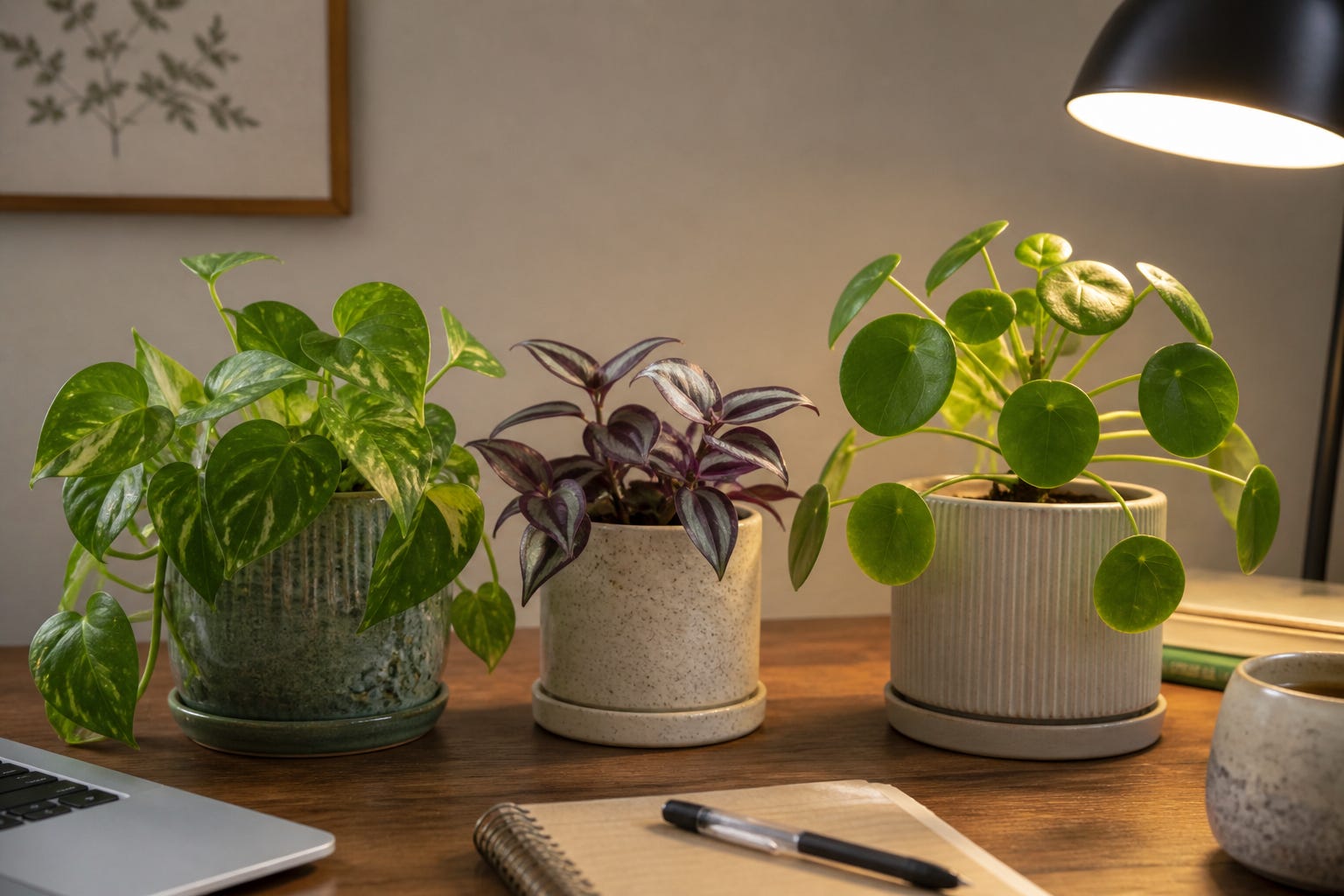
Then I read Zoë’s book. I apologized to the half-dead green and purple survivor, moved it to a place of honor on my desk beneath the grow light — right next to my laptop, where four unrelated plants have taken up residence.
We are all getting along just fine.